The abbey of Egmond and the first counts
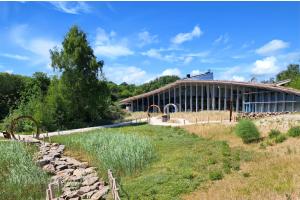
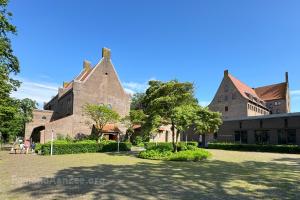
The Sint-Adelbertabdij in Egmond-Binnen is the oldest abbey in Holland and stood at the cradle of the whole region.
- A convent: at the beginning of the 10th century Count Dirk I founded a wooden convent here, after receiving the nearby church in 922 from the West Frankish king Charles the Simple.
- Saint Adalbert: the abbey is named after the missionary Adalbert, a companion of Willibrord, whose remains lie beneath the altar of the abbey church.
- Burial church of the counts: several West Frisian and Holland counts, including Dirk II to Dirk V, were buried in the abbey, which grew into an important religious and cultural centre.
- Destroyed (1573): in 1573 William of Orange had the abbey destroyed by the Beggars under Diederik Sonoy so the Spanish could not use it as a base; its possessions funded the founding of Leiden University.
The castle of the lords of Egmond
The powerful Van Egmond family descended from the abbey's protectors and had a castle in Egmond aan den Hoef.
- From farmstead to fortress: when Beerwout I of Egmont became the count of Holland's deputy in 1129, he fortified his farmstead; the village of Egmond aan den Hoef grew up around it.
- Destroyed and rebuilt: in 1203 the house was destroyed, after which a ring-shaped castle with a heavy tower was built, extended further around 1285.
- Burned (1573): like the abbey, the castle was set on fire by Sonoy's troops in 1573 on the orders of William of Orange; in 1798 it was sold for demolition.
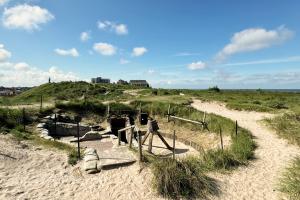
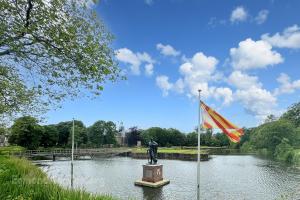
- Rediscovered foundations: in the 1930s the foundations were rebuilt as a job creation project, and together with the moat, a fragment of a tower and the restored castle chapel they now form the Huys Egmont castle ruin.
- Lamoral and Descartes: a statue of Lamoral of Egmont has stood in the moat since 1997, and the French philosopher René Descartes lived for a few years in Egmond aan den Hoef, opposite the castle chapel.
A fishing village by the sea
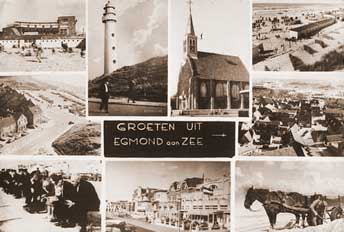
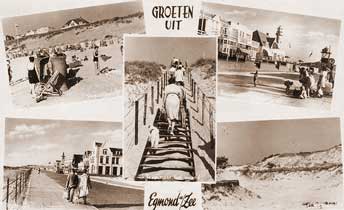
According to tradition, Egmond aan Zee arose behind the dunes in 977 and grew into a true fishing village.
- Ten houses for poor families: legend has it that the wealthy farmer Walgerus from Egmond-Binnen built ten houses for poor families, who were allowed to fish at sea if they gave a tenth of their catch to the abbey; he also founded a small church dedicated to Saint Agnes.
- The pink: around 1400 the pink appeared, a small flat-bottomed boat that was rolled on logs from the boat shed across the beach to the sea.
- Swallowed by the sea: during the All Saints' Flood of 1 November 1570 fifty houses disappeared into the sea, and the Christmas storm of 1741 took another 36 houses and the church with its tower.
- Their own language and faith: Egmond people speak Derpers, a distinctive West Frisian dialect, and the Old Catholic parish of St Agnes is one of the largest Old Catholic parishes in the Netherlands.
Lighthouse, lifesavers and seafarers
The sea off Egmond was dangerous, and the people of Egmond have a long tradition as lifesavers and seafarers.
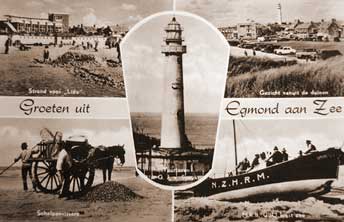
- The first rescue (1824): on 26 December 1824, just over a month after the founding of the Society for the Rescue of the Shipwrecked, men from Egmond carried out the society's very first rescue in a rowing boat.
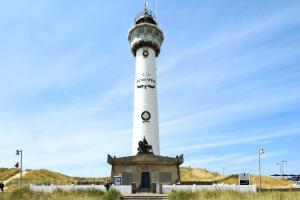
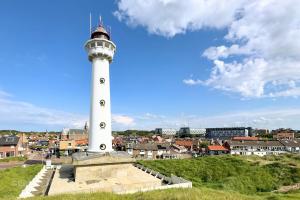
- Two lighthouses (1834): between 1833 and 1834 two lighthouses designed by Jacob Valk were built; one of them became a monument to naval lieutenant Jan van Speijk, who in 1831 blew up his ship rather than surrender it.
- One tower left: in 1891 the J.C.J. van Speijk lighthouse got a revolving light, after which the southern tower was extinguished and demolished in 1915; the light was electrified in 1922.
- A famous lifesaver: Jacob Glas (1832 to 1910), born in Egmond aan Zee, became known for rescuing shipwrecked sailors.
War, convalescent children and seaside resort
In the 20th century Egmond aan Zee changed from a fishing village into a popular seaside resort.
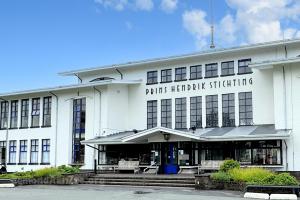
- Convalescent children: in the 1950s many children from other parts of the country were sent to children's homes such as Prinses Beatrix and Huize Sint-Jozef to recover, under a strict regime.
- Municipal reorganisation: in 1978 Egmond aan Zee and Egmond-Binnen became the municipality of Egmond, which merged with Bergen and Schoorl into the municipality of Bergen in 2001.
- A sporty village: every year the Egmond Half Marathon draws thousands of runners over beach and dunes.